
Bowlers Club is reader-supported. Some links on this page are affiliate links: if you buy through them we may earn a commission at no extra cost to you. As an Amazon Associate, we earn from qualifying purchases. How we choose products.
At first glance, all bowling balls look the same. However, there are various types of bowling balls, each with a purpose.
Some are ideal for beginners and are pretty inexpensive, while others are designed for high performance and are used mainly by competitive league bowlers and even professionals.
Whether you’re a casual bowler that comes to the bowling lane once a while, you’ve probably asked yourself a common question: What are bowling balls made of exactly?
Bowling balls may appear simple from an outsider’s standpoint, but they are far from it. They’ve ripened a great deal over the years into a tactile form of high technology!
They may not have exactly started that way. Still, bowling balls have been tempered by years of trial and error, technological advancements to the game, and ultimately technological advancements to the composition of the bowling ball itself. So, what are bowling balls made of? We’ll require a few historical facts to answer that query adequately.
History of Bowling Ball Material and Its Structure
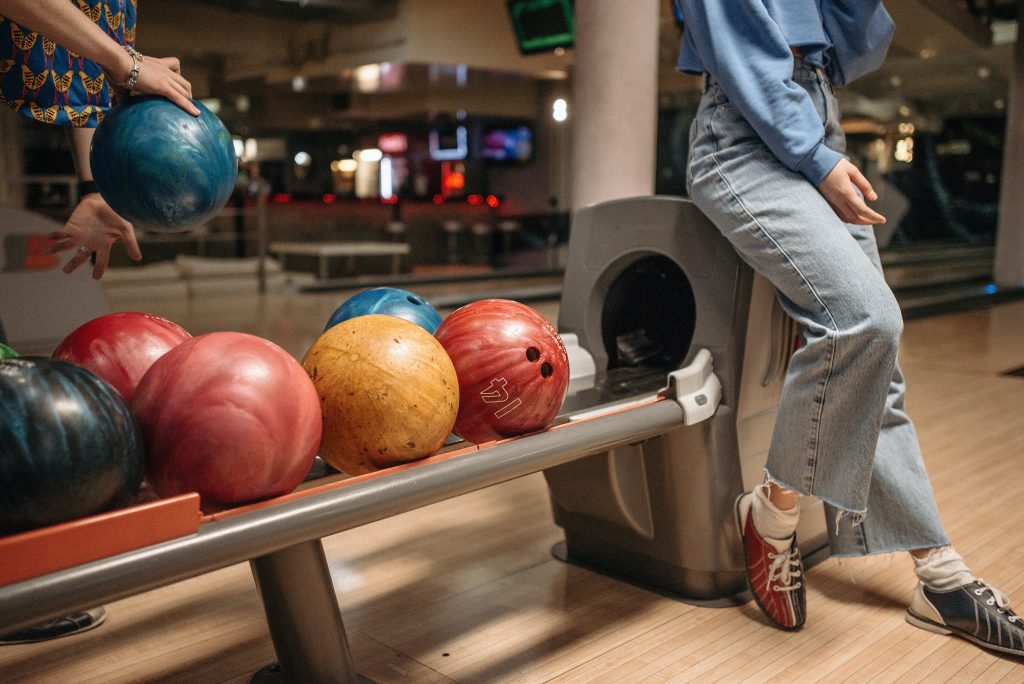
Sixty-five million people in the United States pitch heavy balls down bowling lanes at speeds up to 20 miles an hour every year. Other than the finger holes and eye-catching hues, the balls look simple. However, they are much more than solid spheres that cost between $50 and $300.
Bowling balls are created to perform best on different types of surfaces (lanes are not as simple as they look, either) and to compliment the style and strength of a particular bowler.
Wooden bowling lanes are feted with mineral oil daily to protect them from the friction created by the balls. Usually, the first two-thirds of the lane is oiled rather laboriously (the exact degree differs by the establishment), while the final third is oiled lightly.
As a result, a correctly thrown ball will slide directly down the lane until it meets the less-oiled surface. It will then curve toward the pins as it gains traction. Corresponding the rotational characteristics of the ball to the discharge style and strength of a bowler gives the best results.
Both lawn bowling (balls are rumbled at a target ball) and pin bowling have been recreated for thousands of years. The exhumed grave of an Egyptian child buried 5,200 years ago delivered a set of stone pins employed for a form of bowling.
Lawn bowling was quite famous in Europe during the Middle Ages. In 1366, King Edward III banned the game so his troops would pay more attention to their archery technique. Meanwhile, ninepin bowling (with the pins set in a diamond pattern) was prohibited in Connecticut and New York during the early 1800s. That’s because it was associated with severe gambling. It led to the addition of a tenth pin (set in the now-common triangular pattern) to evade the law.
Lawn-bowling balls are either weighted or shaped asymmetrically so that they will bow when rolled. Balls used in pin bowling must be perfectly round, but they contain hidden weights that affect their balance and rotation. They also vary from lawn-bowling balls by incorporating finger holes; they may include two (for the thumb and middle finger) or, more popularly, three (for the thumb and middle and ring fingers). When a bowler buys a ball, the holes are drilled to fit his or her hand.
Come 1905, the first rubber bowling ball was produced. The Evertrue was a concrete hit, but it wasn’t until Brunswick joined in 1914 with their ball made of a “mysterious rubber compound” that the rubber bowling ball took off worldwide.
Brunswick put a ton of money into making sure their new Mineralite bowling ball was the talk of the developing bowling world, sending Mineralite bowling balls to YMCAs around the United States so that potential consumers could try out the new technological breakthrough.
Rubber bowling balls were a huge success as bowling continued to acquire a foothold with the casual consumer. These early bowling balls had no actual core design to them. Instead, they usually possessed “light density inner-fillers” at the center of the ball. It also has a weight block around the ball’s surface, which could be pinched in its layout to modify its preferred lane path.
The rubber bowling ball’s death knell came a decade or two after developing the plastic/polyester bowling ball in 1959. The last commercially victorious rubber bowling ball was the Brunswick LT-48, presented in the 1970s before losing its market share as the 1980s went on.
The plastic/polyester bowling ball is used in bowling alleys to this day. And it’s a great starting point for answering what a modern-day bowling ball is made of.
Modern Day Bowling Ball Material
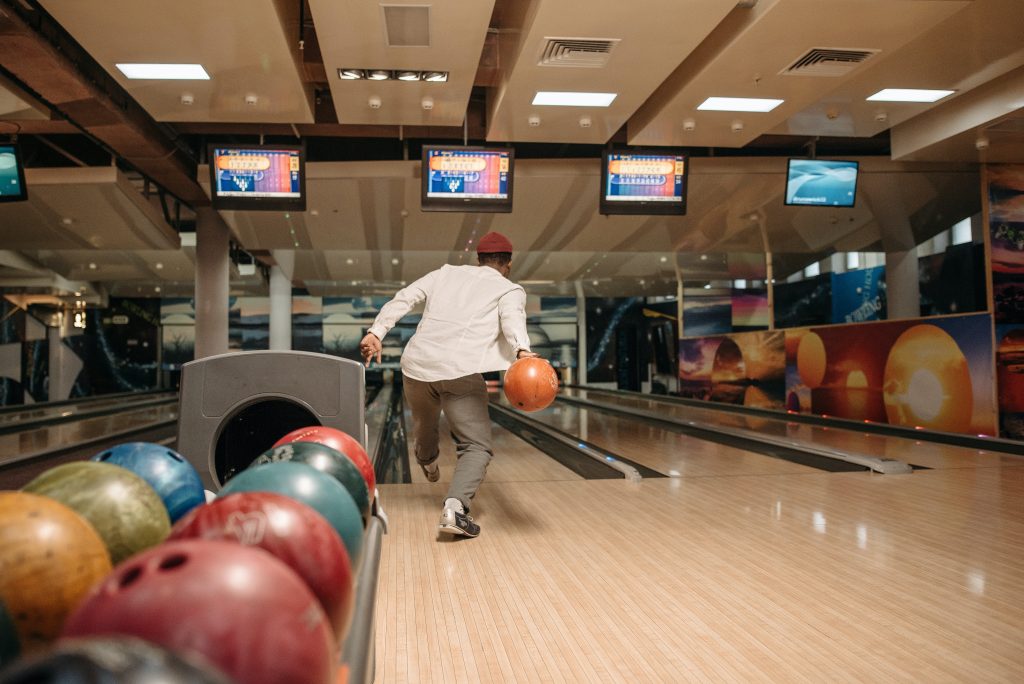
Modern-day bowling balls have evolved from their polyester/plastic bowling ball roots, although plastic bowling balls are still widely used by children and beginners and are the go-to option for many as a straight-line spare bowling ball.
However, the plastic bowling balls’ inefficiency in reacting to lane conditions proved troubling. This is after replacing the rubber bowling ball as the ball of choice at the Professional Bowlers Association tour in the 1970s.
Because these balls didn’t have enough friction to go through the oil on a modern bowling lane, serious bowlers lamented their tendency to skid down the lane and their lack of back-end motion snapping into the pin pocket.
Coverstock
The coverstock or the outer shell of a bowling ball can be made of plastic, urethane, reactive resin, or particles.
Plastic/Polyester
The ball you’ll first encounter on your bowling journey is polyester, also referred to as plastic. These balls are the cheapest and can be used for straight bowlers.
These entry-level balls have been common since the 1960s when they were substituted with rubber bowling balls, which had been the favored material of the previous era.
Polyester bowling balls slide more and have less friction against the lane surface. It allows them to keep a straighter trajectory as they head towards the pins.
Plastic balls are what you’ll see on the racks of your local alley as the “house” balls. However, there’s still an essential difference between those and getting one of your own.
First, you get your ball drilled to fit your hand, and you can choose a style you like and avoid the often dinged and worn-out balls you’ll typically see in the alley.
Urethane
Plastic balls are great for novices, but there comes a time when bowlers ought to graduate to the next level.
That usually comes with urethane bowling balls suitable for intermediate bowlers. These balls were developed in the decade after plastic balls became popular, and one of their primary purposes was to make the ball hook more.
Specifically, the urethane will have more friction on the lane surface, and this reaction causes it to “hook”. A bowler who is just starting to learn how to hook should add a urethane ball to their arsenal.
But when it’s time to “graduate,” don’t toss out that plastic ball. That’s because it’s the straightest type of ball you’ll want to keep to use as a spare ball.
Resin/Reactive Resin
Bowling ball companies have always strived to innovate, as we described in the shift from polyester to urethane, to achieve a coverstock that would hook more.
The final major category of the bowling ball is the same story. This time it came about twenty years after urethane balls hit the market, and the goal was similar: to make the ball hook even more, especially in conditions with heavy oil on the lanes.
These companies started introducing resin particles to a urethane ball to make the ball grip the lane better and hook more. It also hooks well on drier lanes, giving you a powerful strike potential no matter the conditions.
These balls can be called reactive resin or resin balls, and they are the ones most frequently used by competitive bowlers and professionals. There are many subcategories to this final type, as the particles can vary in size and be applied in different quantities.
These make reactive resin balls highly adaptable to suit the needs of more skilled bowlers. In conclusion, what a bowling ball is made of has a bit of nuance.
Plastic balls don’t cost much and are very good for beginning bowlers who throw a straight shot. Urethane balls have improved hook potential on the lane because they yield more friction and are deemed an intermediate step.
Most competitive bowlers opt for a third category, resin or reactive resin, urethane coverstocks with added particles that give strong hook power.
No matter where you are in your own journey, any bowling ball can be helpful. Even for a professional, a plastic ball can be a great spare ball, while urethane balls are great for drier lanes.
The Manufacturing Process
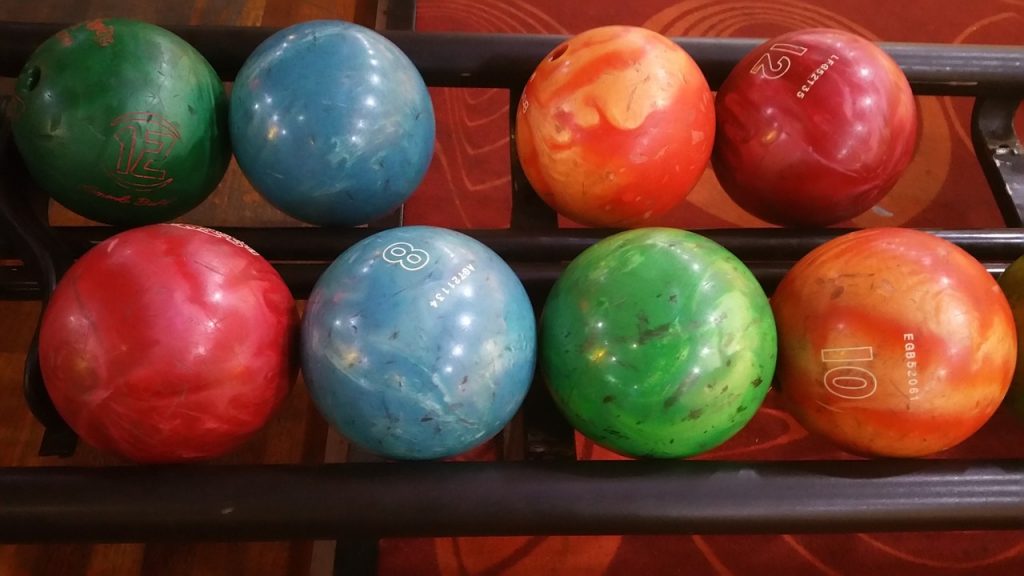
Between the early 1800s and the early 1990s, most bowling balls were constructed of a three-piece structure. A small amount of dense material was poured into a spherical core mold to create a pancake-like core. Then the rest of the core mold was loaded with a less-dense core material.
Finally, the core is placed in the center of the mold then the coverstock is poured around it. Since being pioneered by manufacturer Faball Inc. in the early 1990s, the two-piece structure method has become more widespread.
Making the core
- A mold is formed to the core shape developed during the computerized design process for the particular model of a ball being manufactured. The proper material is poured into the core mold and let to harden. The solid core is released from its mold.
- A second step may be required to finish the core. For instance, some ceramic cores are blasted in a kiln. A compound core is formed by inserting the first core into a second mold and pouring material of a different density around all or part of it.
Forming the shell
- The finished core is set inside a spherical mold named the “coverstock”. The core is bound to a pin that flings inward from the shell of the mold. The pin keeps the core in the proper position. If the pin is tilted toward the center of the mold, it is said to be a “pin in”. It is “pinned out” if the pin is listed away from the center.
- The coverstock material is poured into the mold, wrapping the core, and is set aside to harden. It can be as thick as 1 inch or 2.54cm or as much as 2 inches or 5.08cm. It depends on the layout of the ball.
Filling the gaps
- When the ball is released from the coverstock mold, there is a hole where the core-holding pin remains. A plastic dowel is set inside the hole and cemented in place. After the ball has been bought, the pin will be utilized as a guide for positioning the finger holes to take advantage of the core structure.
- Fill material is added to the logo imprint molded into the ball. It may be the same color as the pin, or it may be a different color. The logo is located at the top of the ball, above its center of gravity.
Finishing
- The ball is finished to the proper size specification by turning it on a lathe and shaving off enough coverstock to achieve the correct shape. They will do it on a centerless grinder and scour the ball into the desired size and roundness.
- Finally, the surface of the ball is finalized to the preferred texture. It is sanded to either a matte finish or to a suitable degree of polish, marked by the roughness of the sanding material (typically ranging from 240-600 grit).
- The ball is placed in a box and shipped to the company’s distributor.
Bowling Balls For Different Types Of Bowling

The technological evolution of bowling balls detailed above has happened in contemporary fashion across the many variations of bowling played across the world landscape.
Some of the composition advancements mentioned above have brought over into niche bowling styles around the globe. In contrast, some bowling game variations have their own unique bowling ball compositions and evolution.
Ten Pin Bowling
Our analysis, as mentioned earlier, of the modern-day bowling ball’s many different iterations and forms is usually an analysis of ten-pin bowling balls.
Ten-pin bowling accounts for the vast majority of bowling alleys worldwide, with bowling balls of varying cover stocks (plastic, urethane, reactive resin, particle) usually drilled with three different finger holes for setting the thumb and middle finger, and ring finger.
The material used as cover stock works as a friction generator and buffer. The friction generator comes with different oil patterns for the modern ten-pin bowling lane. Meanwhile, the buffer shields the core of the bowling ball.
Most bowling balls used in ten-pin bowling at the highest levels are made of reactive resin coverstock technology. However, plastic, urethane, and particle bowling balls are also ubiquitous at most bowling alleys around the US and the world.
Five Pin Bowling
Five-pin bowling still has a significant footprint all over Canada, with five-pin bowling lanes proliferating the landscape in every Canadian province.
A five-pin bowling ball is typically made of a rubber/synthetic combination at a proportion of four to one or greater. For the most part, these bowling balls are created without finger holes and are about the size of the average adult hand.
Five-pin bowling was created in Toronto back in 1909 as a direct response to bowling consumers who felt the standard ten-pin game was too stressful and required too much physical investment.
The only valid regulation for five-pin bowling balls is that they cannot have any metallic component. It led to the creation of some of the cover stock and synthetic composition elements of ten-pin bowling balls into the technology for some modern five-pin bowling balls. However, rubber bowling balls remain the widespread name of the game for this Canadian forte.
Duckpin Bowling
A duckpin bowling ball follows the same weight and size specifications as a five-pin bowling ball. It is usually made of a similar rubber/synthetic hybrid to that of their five-pin counterparts – also usually without finger holes.
Many bowling balls created for the squat ten duckpin structure find their way into five-pin bowling alleys north of the border and vice versa.
You can find duckpin bowling alleys in several states in the Northeastern United States. However, the amount of duckpin bowling alleys has dwindled considerably since the sport’s heyday in the early 20th Century.
All duckpin (and five-pin) bowling balls must have between 4.75 inches and 5 inches in diameter. They should also weigh between 3 pounds 6 ounces and 3 pounds 12 ounces. About the size of a regulation softball, duckpin bowling balls have diameters over 60% smaller than a regulation ten-pin bowling ball.
You can also find these duckpin bowling balls at arcades and entertainment centers around the United States and the world, where a miniature ten-pin bowling game is present.
Candlepin Bowling
Candlepin bowling is a unique variation of bowling where the bowling ball is lighter than each of the ten thin, candle-Esque pins placed at the end of the alley!
Played mainly in the Northeastern United States and Canadian maritime provinces, candlepin bowling balls are permitted to be made of wood, rubber, plastic, or a combination of these materials. Candlepin bowling balls are allowed to weigh from 2 pounds 4 ounces to 2 pounds 7 ounces. It is 0.5 inches smaller in diameter (4.5 inches) than a duckpin/five-pin bowling ball! These, of course, typically have no finger holes.
If you ever play candlepin bowling, you’ll detect two things. Firstly, the ball runs off the pins hard because candlepins are 2 pounds 8 ounces – heavier than the heaviest candlepin bowling ball. Secondly, a candlepin bowling ball is small enough to be tossed between pins set up in the same row.
It makes it much harder to find a pocket and generate pin carry!
Do Bowling Balls Float?

Whether bowling balls float will depend on their weight. Each different bowling ball weight has a different density, with a regulation 12-pound bowling ball being the closest in thickness (0.99 grams/centimeters cubed) to that of water (1 gram/centimeter cubed).
Therefore, a regulation bowling ball that is 12 pounds or lighter will float in water if it hasn’t been modified! Balls that are 13 pounds or heavier will surely sink because their overall density is greater than water.
Do Bowling Balls Go Bad?

Bowling balls don’t spoil, but they also have a lifespan. If you clean your bowling ball regularly and do all the needed routine maintenance, there is a perfect chance that your bowling ball will maintain efficacy and overall quality for five to ten years.
The two main worries for your bowling ball’s overall longevity are the condition of the cover stock and its core. The problem with modern high-performance bowling balls is that they are constructed with cover stocks that are absorbent and softer than older bowling balls for lane movement.
It is all well and good when a bowling ball is in great shape, but it also can direct to an improperly-maintained bowling ball cover stock cracking or chipping over time. And in fact, this only happens anyways with a case of bad luck.
A cracked bowling ball coverstock is the death knell for a bowling ball, as is a potential core separation. If a bowling ball core comes apart or loses its stationary position in the depths of your bowling ball, it can totally hurl your ball off balance and turn it into nothing more than a very expensive paperweight.
In short, bowling balls are finely-tuned technological structures that last as long as the technology is in good enough condition. If the cover stock or core of a bowling ball is severely compromised, you’re likely to have to buy a new bowling ball.
Final Thoughts
So, what are bowling balls made of? The answer isn’t exactly simple.
Bowling balls have evolved from simple wood and rubber spheres with limited technological import into machines that have been repeatedly tweaked – chemically and structurally. This is to maximize their efficiency and effectiveness.
A modern bowling ball is much, much more than meets the eye! Nonetheless, it needs to be examined to appreciate just how much work it takes to make a modern bowling ball go.
References:
- What are Bowling Balls Made Of? Top Materials and Coverstocks: https://beginnerbowlingtips.com/what-are-bowling-balls-made-of
- What Are Bowling Balls Made Of?: https://skilledbowlers.com/bowling-balls/what-are-bowling-balls-made-of/
- Bowling Ball: https://www.madehow.com/Volume-4/Bowling-Ball.html
- What Are Bowling Balls Made of (All You Need To Know): https://bowling.zone/what-are-bowling-balls-made-of/#Takeaways
- What Are Bowling Balls Made Of?: https://www.starsandstrikes.com/blog/what-are-bowling-balls-made-of/#:~:text=Overall%2C%20bowling%20balls%20can%20be,the%20oils%20on%20the%20lane.
Looking for more bowling items?